A project to photograph every wall ghost in Newport, Isle of Wight.
Walking the streets of Newport for many years has given me the opportunity to notice the old painted signs on the walls of a few of the buildings. The first two that left an impression on me were the Coal Wharf and Moorman. In my head I called them wall ghosts, because they link us to a past that is gone but that we can still think about today. Perhaps my ancestors went to Moorman for a carpet, or lit a fire in their home from coal that was unloaded at the Wharf.
I wondered how many more of these wall ghosts I could find, and if I could capture them for other people to enjoy looking at. There are 19, listed below in alphabetical order.
Have I missed any of Newport’s wall ghosts? Contact me if you know anything about these glimpses of Newport’s fascinating past.
My definition of a wall ghost:
- A hand-painted sign …
- painted directly onto the wall …
- advertising a business that no longer exists.
The signwriter (almost certainly a man) would have worked from a ladder or scaffolding, with a constant stream of people walking past them on the busy streets. This was not without its risks. One of my nineteenth century ancestors died by falling off a ladder. When I discovered this about ten years ago it confirmed my mistrust of heights. Did the signwriter find it easy to focus on their task given the risks?
4 DOLPHIN
10 MAKER
12 SAVINGS BANK
13 SCOOTER ACCESSORIES / BOROUGH HALL MOTORS
14 SCOTT & SON
16 and 17 SHEPARD BROS
18 WADHAM
SUGGESTED WALKING ROUTE
I have chosen a route which aims for efficiency and reduction of too much back-tracking. It also keeps you on the safer roads for pedestrians to navigate. Allow 90 minutes to two hours for the entire route, but this will depend on how long you spend admiring each wall ghost.
Start on Carisbrooke Road with WRAY & SONS.
Head into Newport. Turn left on to Mill Street for SAVINGS BANK.
Continue along Mill Street. Turn right on to Crocker Street. Turn left on to St James’ Street. Continue over the traffic lights as the road becomes Hunnyhill. Cross to the other side of Hunnyhill for SCOOTER ACCESSORIES / BOROUGH HALL MOTORS.
Turn back on yourself. Head back into the centre of Newport. Make your way to Pyle Street for WADHAM.
Continue down Pyle Street for Foundation Bakery.
Return the way you came, up Pyle Street. Cut through St Thomas’ Square. Turn right on to High Street. Walk down to SELF PASTRYCOOK. You can see this one coming from a distance.
Walk back up High Street. Turn right on to Holyrood Street. Turn left on to Crocker Street. Turn right on to St Cross Lane for FISK & FISHER.
Retrace your steps. At the end of Crocker Street turn left on to Holyrood Street, then right on to Sea Street for COAL WHARF.
Continue along Sea Street. Turn left on to Little London for the two SHEPARD BROS signs.
Retrace your steps to Sea Street. Continue down to The Quay for DOLPHIN.
Walk down The Quay, alongside the River Medina, for JUBILEE STORES.
Retrace your steps to Sea Street. Walk to the end of Sea Street. Cross the bottom of High Street. Walk along East Street. Turn left on to Furrlongs. Cross to the other side of the A3020 for LEIGH THOMAS.
Retrace your steps to Furrlongs. Turn left on to South Street. At the top of South Street is McDonalds. Find the start of Scarrots Lane for MOORMAN & SON’S.
Retrace your steps for a short distance. Turn to Upper St James’ Street. Look above the Oxfam shop for MAKER.
Further along St James’ Street on the same side is BOARD SCHOOLS.
Further along St James’ Street on the opposite side is Cranbourn Rest.
Walk up St John’s Place. Turn left on to Medina Avenue. Turn right on to Mount Pleasant Road for SCOTT & SON.
Retrace your steps to the junction of St John’s Place and Trafalgar Road. Turn left on to Trafalgar Road. At the end, turn left on to Carisbrooke Road. Continue to HOWARD CAUSTON.
1
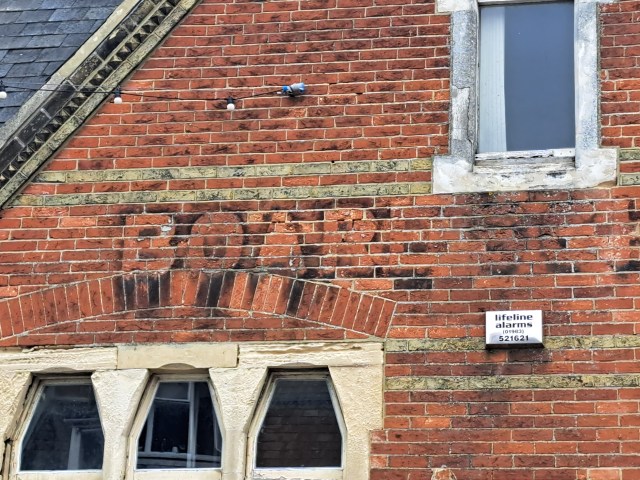
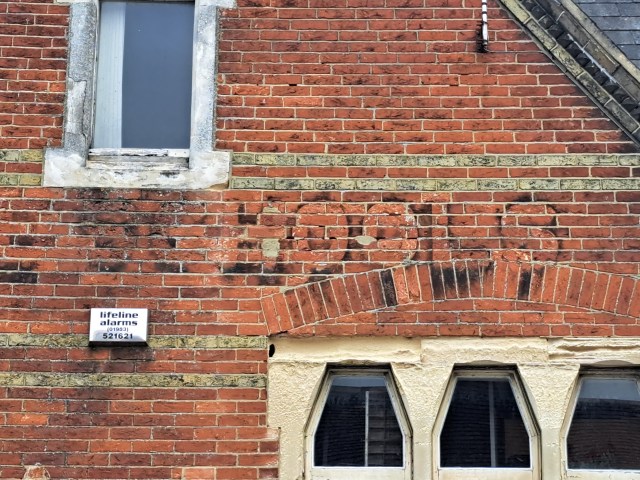
BOARD SCHOOLS
Location: next to 54 St James’ Street, PO30 1LQ
In June 2024 this was occupied by The Island VI Form.
It was occupied by the Isle of Wight Schools Library Service until February 2001.

The 1898 Kelly’s Directory tells us that the building was built in 1812 and originally known as the Lancastrian School, then later the Royal British Schools. It transferred to the Newport Board in 1875, was enlarged at a cost of £1200, and reopened on 3 January 1876. It was enlarged again in 1896 with the intention to hold 710 children. The average attendance was: 261 boys, 256 girls, 252 infants.
On reopening in 1876, the headmaster was Anthony Gill-Martin. He continued in that role for 30 years. In 1907 he was elected Mayor of Newport. He died in 1909 at the age of 66. The Friends of Newport and Carisbrooke Cemeteries have transcribed the Isle of Wight County Press report of his death.
A closer look at the words:
2
COAL WHARF
Location: 3 Sea Street, PO30 5BU. The ‘Crooked Cottage’.
A listed building.

The word WHARF is fairly easy to read. The ‘C’ from COAL is missing, but the ‘O’ and the ‘A’ can be picked out. From close up the ‘L’ is more visible.
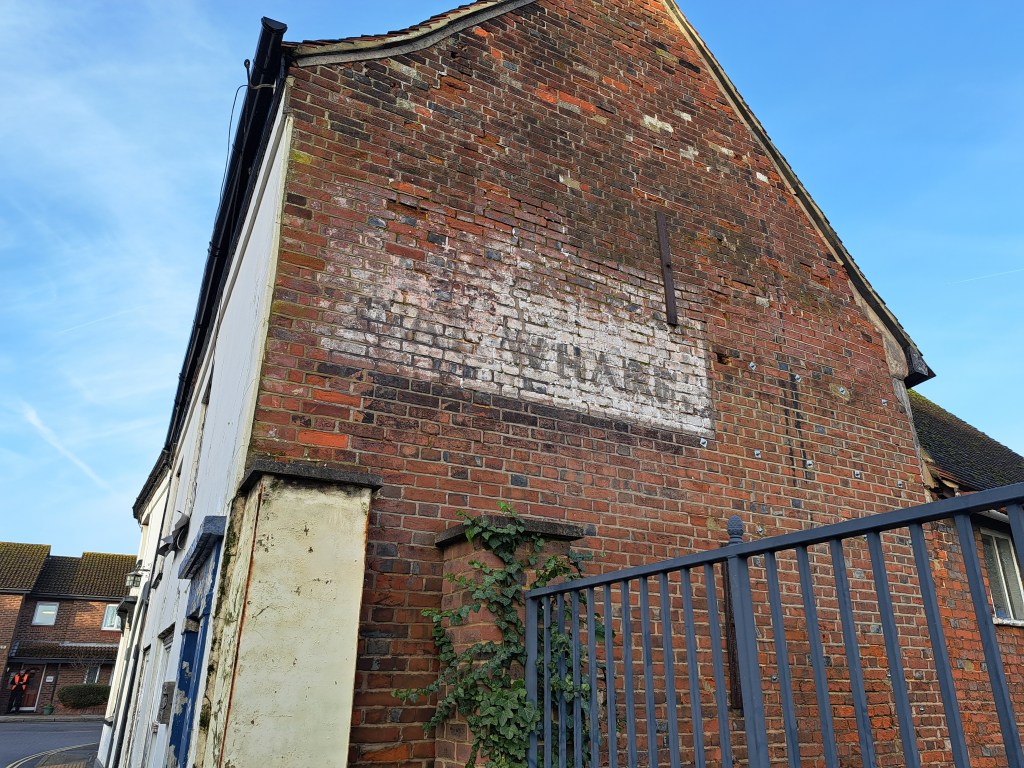
I like to picture the ships bringing the coal up the River Medina to Newport, then unloading it on the Quay. Later in the nineteenth century the coal would have been carried on the new Cowes to Newport railway line which opened in 1862.
I took the photo above on 24 January 2024. It pays to look at these wall ghosts from different angles. On 18 July 2024 I looked at it from inside the car park, on the other side of those railings. For the first time I noticed that each letter uses three-dimensional shadowing to make it stand out from the wall. The shadows are to the right and below each letter. I am investigating if I can use this knowledge to help put a date on when the sign was created.
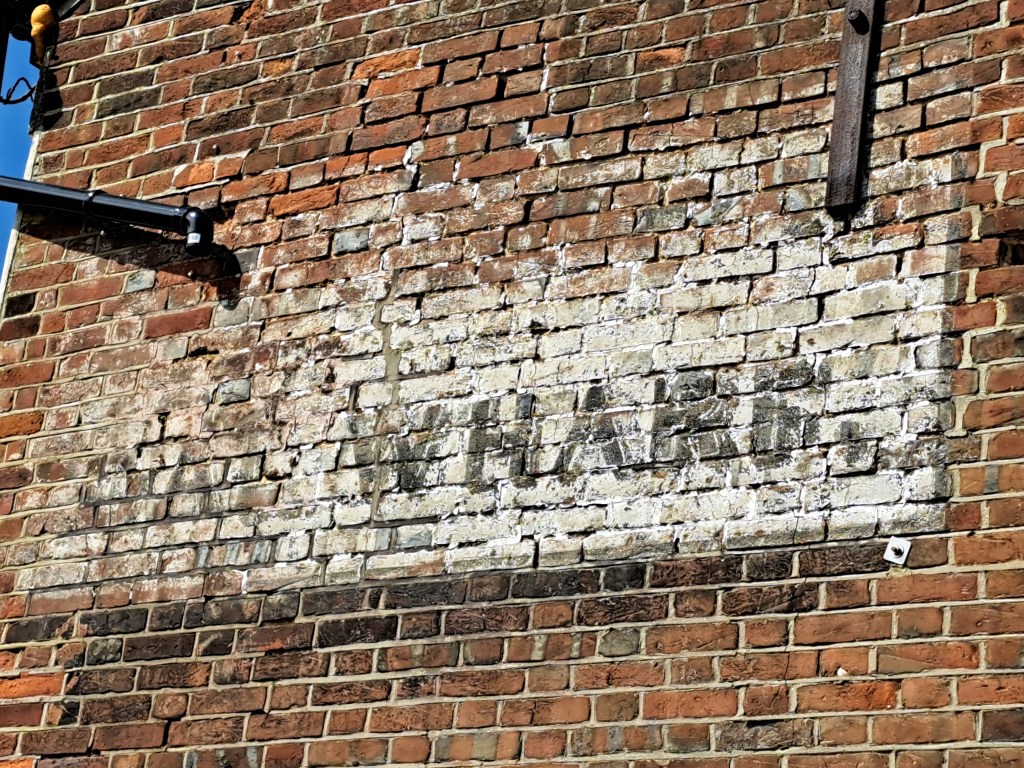
My research has revealed several candidates for the owner of this Coal Wharf, but it isn’t possible to say with confidence which name would have appeared on this sign.
The candidates include:
Robert Jewell
George Vallance
George W Locke
William Woodward
Frank Way
H A Dore
Alfred Harley
Wheeler and Hurst
3
Cranbourn Rest
Location: 62-63 St James’s Street, PO30 1LQ
The building is now split between a branch of the Co-operative Funeralcare and The Kebab House.
Formerly a public house, the Cranbourne Arms.
A listed building.
I love the typeface. I think it is ‘Old English’, a blackletter (or Gothic) typeface. This is most decorative of all Newport’s wall ghosts. The Isle of Wight County Press use the same ‘C’ in their name.
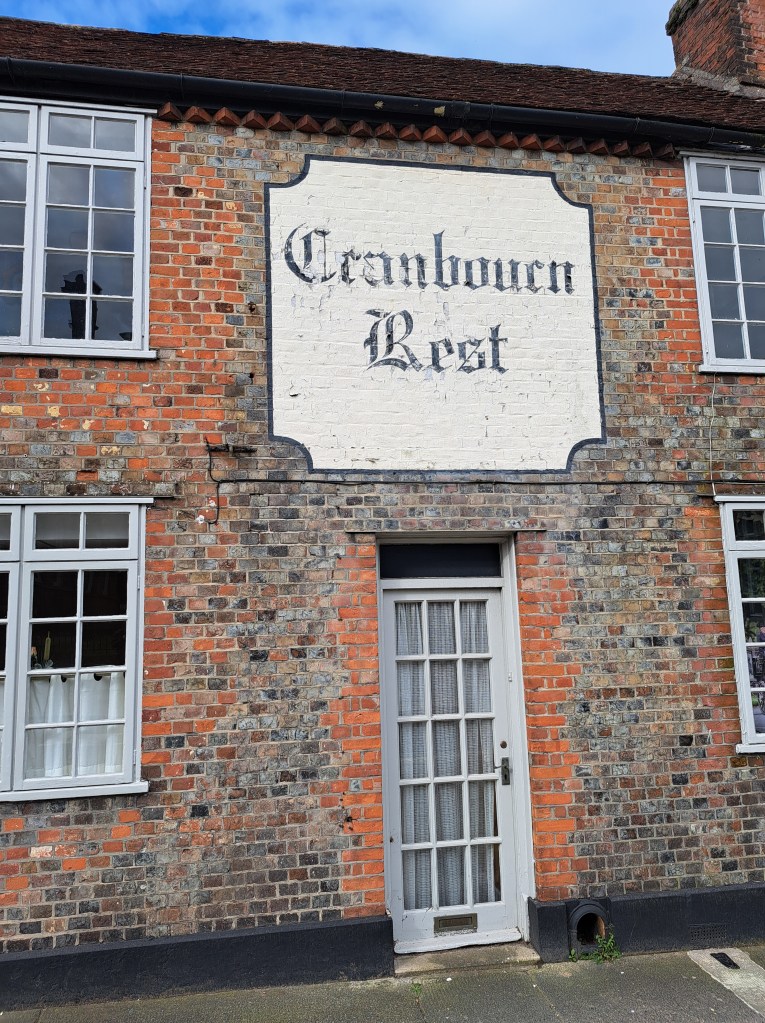
Edward William Way, aged 23, was seriously injured in a fight outside the Cranbourne Inn on the evening of Sunday 12 May 1889. He died a week later at his home in Field Place. The Friends of Newport and Carisbrooke Cemeteries have transcribed the Isle of Wight County Press report of the inquest into his death.
To make a satisfying connection to an earlier wall ghost, Edward was a pupil at the Board School. He was 10 when the school reopened in January 1876. Page 35 of ‘Every Picture Tells A Story’ by Bill Shepard and Brian Greening (2005) tells us that Edward was described by his father as a “confirmed truant”. After being “given numerous chances”, the headmaster “declined to readmit” Edward many months later.
4
DOLPHIN
Location: 40 Sea Street, PO30 5BW
Formerly the Dolphin Inn. The ground floor is a holiday apartment.
Like many of Newport’s older buildings, some of the windows have been bricked up. Was this to avoid paying the window tax, introduced in 1696 and repealed in 1851?
A listed building.
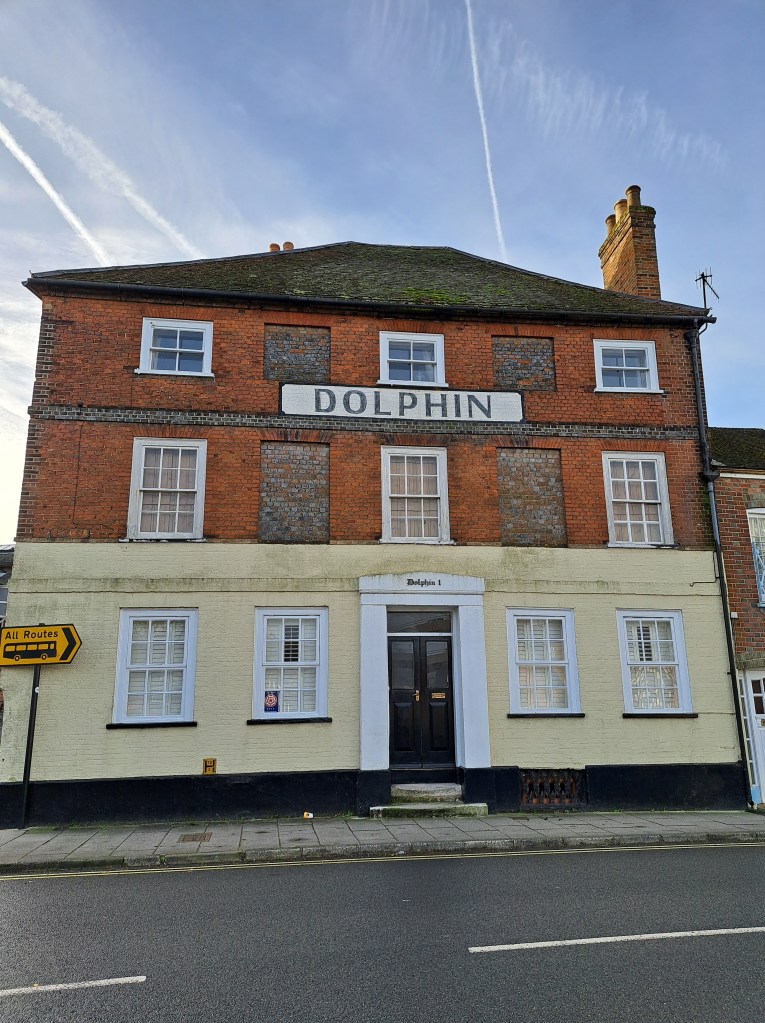
The Dolphin was an interesting choice of name for this Inn. Newport is not known for its abundance of highly intelligent marine mammals. If you know of an historic sighting please contact me.
A likely explanation for the name can be found in The Dictionary of Pub Names (Wordsworth, 2006), which tells us that “the dolphin was looked upon by ancient seamen as a friendly creature who would help them in a storm by twining itself around the anchor cable. This would prevent the anchor from dragging and secure the safety of the ship. With such a reputation it was not surprising that Dolphin became a much used ship name, being used in the Royal Navy from 1648 to the present day.” Botley, Southampton and Portsmouth all have pubs called The Dolphin.
An image of a dolphin appears in many coats of arms, including the Fishmongers’ Company and the Company of Watermen and Lightermen of the River Thames.
In April 1800 two British militiamen were murdered by five Dutch sailors and soldiers in The Dolphin. This report was published in the Reading Mercury on 14 April 1800:
“Newport, (The Isle of Wight), April 8. On Saturday afternoon were interred in the church-yard of this place, John Light and George Sainsbury, two remarkably fine men, grenadiers of the North Hants regiment of Militia, on whose bodies the coroner’s inquest sat a few days before, and brought in a verdict of wilful murder (both being stabbed with knives) against four Dutch sailors and soldiers, since committed, with a fifth, accomplice, to Winchester gaol.
The Commanding and other Officers of the corps, wishing to testify their regret for the deceased, as well as their approbation and respect for their good conduct and characters while living, attended, and marched in the procession of the funeral, with the whole of the regiment off duty.
The corps of Dutch officers exerted themselves to bring the perpetrators of this unprovoked assassination to punishment, and as a proof of their regret, begged to be permitted to join the procession. The Dutch privates joined their officers in a subscription for the widows and children of the deceased, which amounted to 300l [£300]. This very liberal donation is an honourable testimony, how deeply and how laudably the whole corps have been affected by the vile conduct of a few among them.”
This was indeed a liberal donation. The Bank of England’s inflation calculator tells us that £300 in 1800 is worth just over £21,000 in 2024.
Around the corner on Quay Street, some more nice paintwork:


5
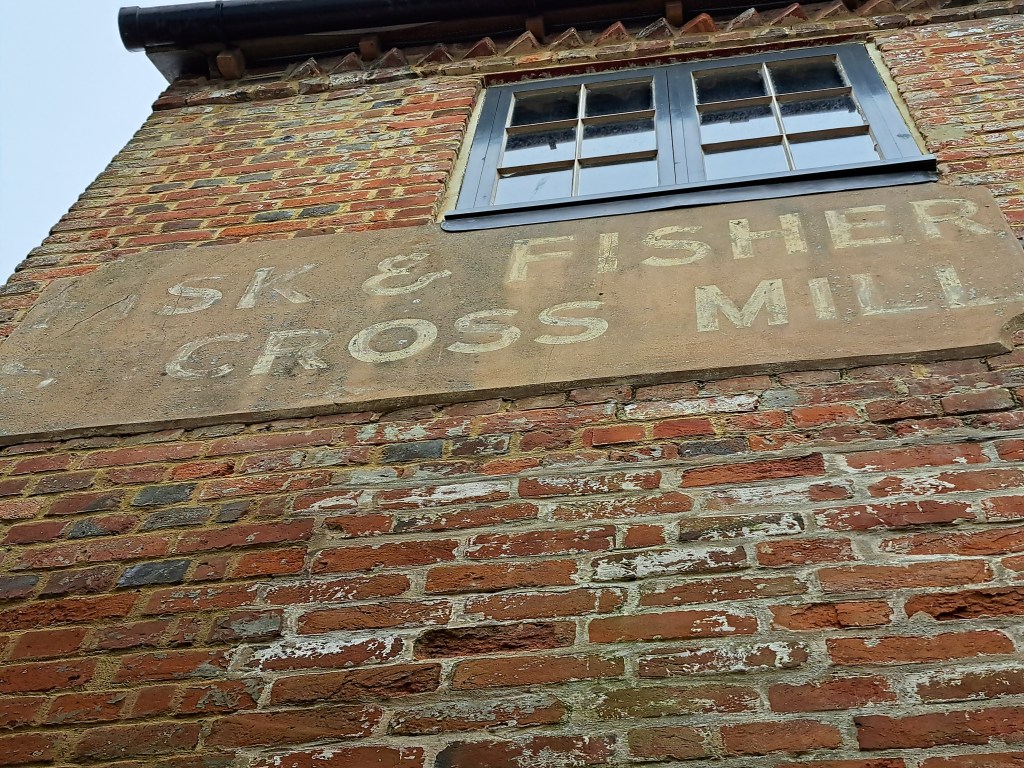
FISK & FISHER
ST. CROSS MILL
Location: St. Cross Lane, PO30 5BZ.
Very much a listed building.
Fisk & Fisher sold cattle feed.
Jim Fisk was a farmer.
The Friends of Newport and Carisbrooke Cemeteries have transcribed the Isle of Wight County Press report of the death of William Fisher in 1915 (transcribed by Rosemary Stewart).
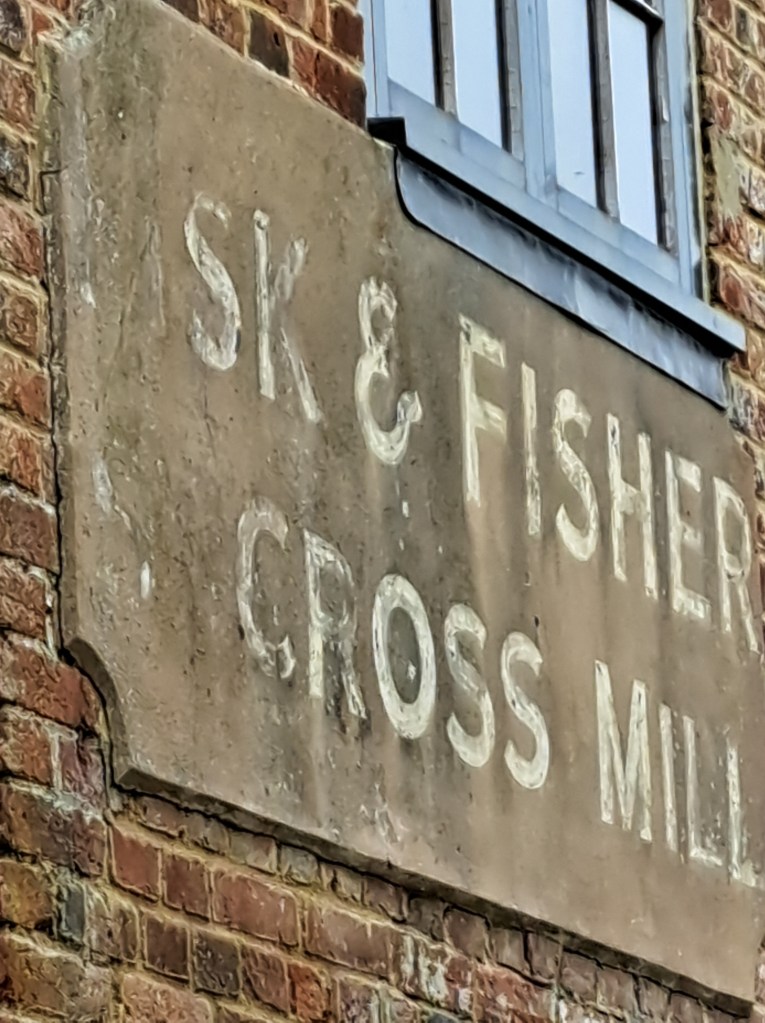

St. Cross Mill features on The Mill Trail Heritage Walk.
6
Foundation Bakery
Location: 16 Pyle Street, PO30 1JW
A strange one, this. The sign only dates from 2013, but looks much older. The Bakery opened in March 2013. It was still going in 2014 but closed not long after. It is now a charity shop for the Ability Dogs 4 Young People.

7
HOWARD CAUSTON & CO
MOTOR & GENERAL ENGINEERS
AND MILLWRIGHTS
Location: adjacent to 178 Carisbrooke Road, PO30 1DQ.
The site is known as the Lukely Works. The current occupier is Ceramic Substrates.
There’s a nice description on the Historic England website of how this wall ghost came to the attention of the grandson of Howard Causton. They have managed a full transcription which is impressive given how faded the lower part of the sign is.

A different angle:

A closer look at the lower part:

This wall ghost differs from the others in that it is not painted onto brick. It is on slate tiles. It looks like it could be stencilled on. I claim no expertise in this area, so contact me to share your thoughts. I’ve had to widen my definition of a wall ghost to include it, but it would be churlish not to have done so. You might also wonder if this wall ghost is actually located in Newport. It begs the question, ‘Where does Newport end, and Carisbrooke begin?’ Finer minds than mine are still pondering this.
I live relatively close to this wall ghost. I must have walked past it hundreds of times and never noticed it until I started this project. What is wrong with me?? The moral of the story … remember to look up and look closely and you never know what you might discover.
8
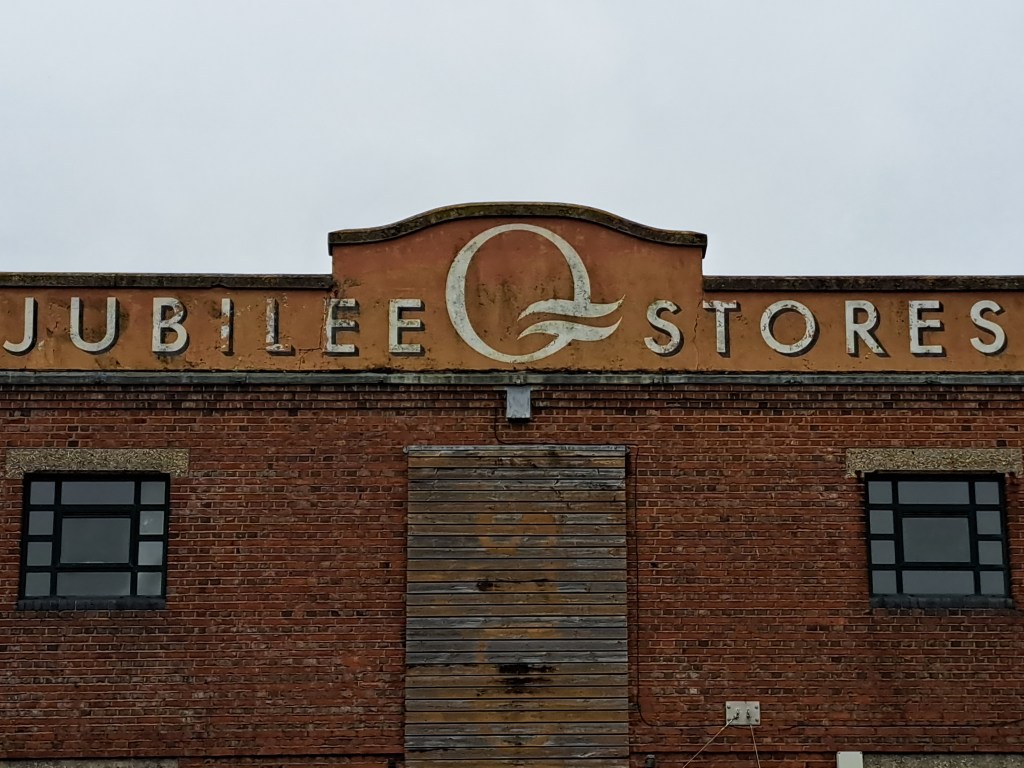
JUBILEE STORES
Location: The Quay, PO30 2EF
Currently occupied by Quay Arts. It houses seven artist’s studios. It used to be a grain store.
Along with the Coal Wharf, the only wall ghost where the signwriter has used shadowing to create a three-dimensional effect. The Q was added later.
9
LEIGH THOMAS & CO. LTD.
Location: Mill Court Business Centre, Furrlongs, PO30 2AA
The Business Centre’s website gives the history of Pan Mill, which dates back to at least the 14th century. They include several old photos.
This National Archives record contains some more background information.
A listed building.
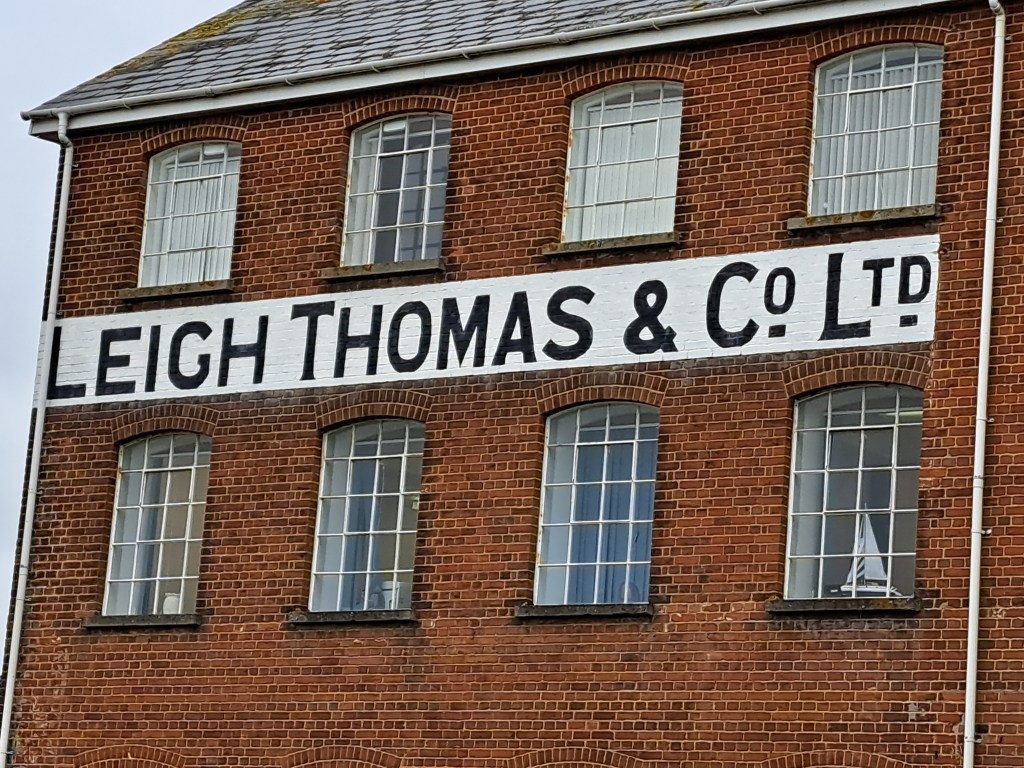
The largest of Newport’s wall ghosts and probably the easiest to read. Leigh Thomas and Co. Ltd. was formed in 1935. Is this the original paint work from that time? The manager of the Business Centre told me in a phone call that she believes it has not been repainted. She added that this side of the building has weathered well and the bricks are in good condition.
I want to ask the question, ‘If you repaint a wall ghost to preserve it, do you change its character?’ For all of these wall ghosts, you are looking at the original paint work which has started to fade away. I incline towards letting them fade away, but taking lots of photos so they are part of the historical record.
10
MAKER
Location: 35 St James’s Street, PO30 1LG
It looks like it’s above the Oxfam shop, but it’s further back on the side of the building currently occupied by the game shop Warhammer. Next door at 36 is Eldridges, the solicitors.
A listed building.
The most enigmatic and tantalising of Newport’s wall ghosts. The line above MAKER is in italics. Is it B, I, N, E? Giving us the word CABINET? Every time I look at it I feel I’m getting closer to reading it, but I’m still so far away.


Not very sophisticated I admit, but my attempt to show what could be the letters B, I, N and E. After E you can see the start of T:

William White’s 1859 Isle of Wight Directory tells us that 36 Node Hill was occupied by George Newman Henton, a cabinet maker. In 1861 Node Hill was renamed Upper St James’s Street, but the property numbers were unchanged. So we can place a cabinet maker next door to number 35. Number 35 itself was occupied by Eldridge, the solicitors, for many decades, from at least 1875 to quite recently.
The Post Office Directory from 1875 tells us that number 36 was occupied by Lieut. Col. Francis Feneran. Going back to the 1871 Census, George Newman Henton, a ‘Retired carpenter’, was living at 88 Carisbrooke Road. The 1861 Census puts George Hanton (wrong spelling in the transcription) in Node Hill (no house number given) with an occupation of ‘Carpenter master employing 3 boys’. So some time between 1861 and 1871 George retired and moved from Node Hill to Carisbrooke Road, only a few minutes’ walk.
George Newman Henton was born in 1815 and died in 1894. He is buried in Carisbrooke (Mount Joy) Cemetery. There is a better photo of his grave on the Friends of Newport & Carisbrooke Cemeteries website.
So I’ve put some facts to the life of George Newman Henton, but there is no proof the sign was advertising his business.
The Newport and Carisbrooke Heritage Society added my photo to their Facebook page. People indentified nearby buildings and previous businesses, but nobody was able to decipher the writing.
There must be someone who remembers this sign before it faded. Do contact me if you know more.
11
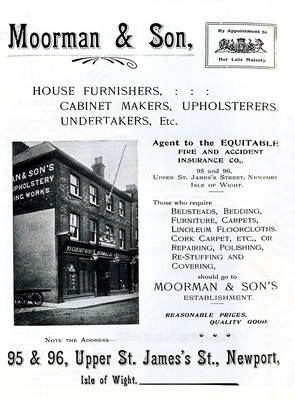
MOORMAN & SON’S
CABINET, UPHOLSTERY
AND POLISHING WORKS
Location: 95-96 St James’s Street, PO30 1HY
The photo was taken from Scarrots Lane. The ground floor is currently occupied by Richmonds Bakery.

The Wootton Bridge Historical website has a collection of old advertisements from Newport, where I found this image:
12
SAVINGS BANK
Location: next door to 7 Mill Street, PO30 5DD
Very faded, this one.

Zoomed in – SAVINGS

Zoomed in – BANK

Above the door – ISLE OF WIGHT

Wightpedia has an entry on the Bank.
13
SCOOTER ACCESSORIES / BOROUGH HALL MOTORS
Location: 9 Hunnyhill, PO30 5HJ.
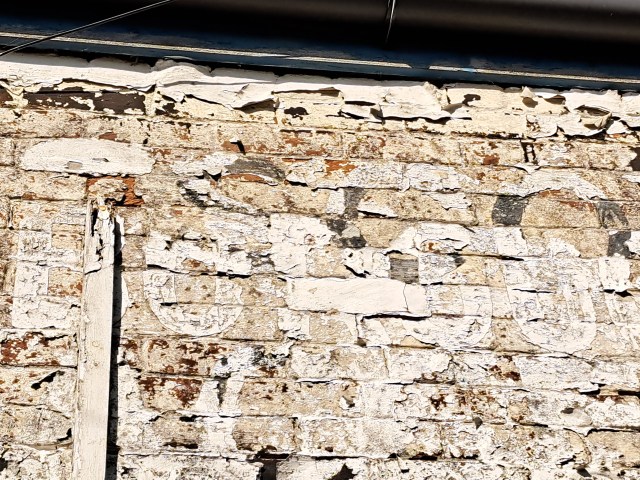
I found this on 4 October 2024 as I walked up Hunnyhill. It would have been easy to dismiss this wall as consisting of flaking paint and nothing more.

Closer inspection revealed it to yet another wall ghost (the 18th I found). Even more exciting, it’s a double wall ghost. The first sign advertised SCOOTER ACCESSORIES. On top of that was painted BOROUGH HALL MOTORS.
In the photo below, look for S C O O T in faded black.
Then below, and starting further left, look for B O R O U G H. Continuing on this line, but not shown on this photo, is H A L L.
Then below, look for A C C E S. The A starts under a vertical block of wood. After the S is another piece of wood.

Below, the O T E R of Scooter:

Another view:
Inside the building is a sign which is believed to have belonged to Borough Hall Motors.
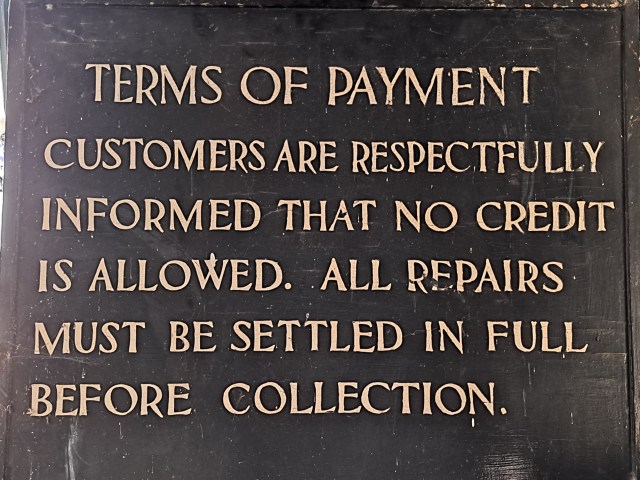
Too right … I wouldn’t allow customers credit either.
The building is now occupied by Hunnyhill Motorcycles. I interupted Olli the mechanic during his working day. He patiently told me what he knew about the history of the building. His business has been on this site since 2018. Before that it was The Old Curiosity Shop, an antiques shop. Going back in time, it was IOW Motorcycles, Borough Hall Motors, Scooter Accessories, a private house and various Blacksmiths. I then went away and did my own research.
The first image in this document is Samuel Hewitt’s view of Newport from Hunnyhill, painted in 1791. The Town Gate mill and millpond are clearly visible. 9 Hunnyhill would be to the left of the brown horse. Inevitably, it isn’t possible to take the same photo today, due the houses on Hunnyhill and Grange Drive.
From the 1880s to the 1940s this site used to a Blacksmiths. It seems very apt that the building now services motorcycles. What is a motorcycle but a kind of mechanised horse? The fact that the engine can be measured by it’s horsepower says it all. Blacksmithing is an ancient craft with a captivating history.
We start with the 1881 Census, and the Hookey family. (There are no property numbers for Hunnyhill in this census, but I’m confident I’ve identified the correct family).
Henry Hookey, aged 38, born 1843. Occupation: Blacksmith
Anne Hookey, wife, aged 32, born 1849. Occupation: Blacksmith’s wife.
They have three children: Florence, aged 12; Bertha, aged 10; James, aged 3.
Henry Hookey advertised his business in the Isle of Wight County Press from 15 May 1886 to 7 May 1887:

The 1891 Census has inconsistent property numbers for Hunnyhill.
At Leigh Terrace, 3 Hunnyhill, we find Henry Hookey. He is now a widower. Aged 48, born 1843. Occupation: Blacksmith. He is living with his five children, aged from 2 to 22.
Confusingly, there is also a property called Blacksmith’s Cottage. Was this 9 Hunnyhill? The occupants were:
Elizabeth Rolf, widow, aged 35, born 1856. Occupation: Dressmaker.
She has two daughters: Ellen, aged 9; Daisy, aged 1. Also present are a grandmother (Charlotte Greenen) and a lodger.
Did Henry Hookey move to a better property a little bit down the hill? If so, did he still run his business from number 9?
Even more confusingly, the 1891 Census has another Blacksmith at Leigh Terrace, 5 Hunnyhill – Edward T Hall. To add to the mix, on the other side of the road at 6 Hunnyhill was Oliver Coombes, a Blacksmith.
Switching briefly to newspaper searches, a man called Frank Hawkins advertised himself in the Miscellaneous section of the Isle of Wight County Press on 12 May 1894:

The 1898 Kelly Directory lists a Frank Hawkins as a Blacksmith on Hunnyhill.
On 16 July 1898, The Isle of Wight County Press reported this sale (along with others which I have not copied):
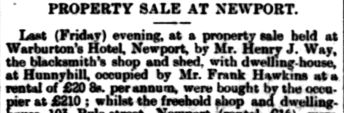
On the 1901 Census, at 9 Hunnyhill, we find …
Frank Hawkins, aged 47, born 1854. Occupation: Shoeing Smith. Birth place: Godshill.
Annie L Hawkins, wife, aged 42, born 1859. Birth place: Whippingham.
There are four daughters: Alice L, aged 19; Hilda B, aged 6; Ada F, aged 5; Annie M P, aged 3.
A search of marriage records show that Frank and Annie married in 1877 (Q1) in Whippingham.
So in 1901 Henry Hookey is no longer linked to 9 Hunnyhill. But he is still in Hunnyhill! He has moved up to 61 Hunnyhill. He is now 58 but is not retired. His occupation is still given as Blacksmith. He is living with three children. Was there enough business for two Blacksmiths on the same stretch of road? It’s a puzzle. Henry Hookey is still at 61 Hunnyhill on the 1911 Census. This time he is (at 68) a Retired Blacksmith. He is living with three children and a grandchild. Old Henry had good genes: he is still alive (at 78) at the time of the 1921 Census, and still at 61 Hunnyhill. Now he has two adult children living with him. As well as being a Retired Blacksmith he is also an Old Age Pensioner.
Back to the Hawkins family. They are still present at 9 Hunnyhill on the 1911 Census.
Frank Hawkins, aged 51, born 1860. Occupation: Shoeing Smith. (Note the 6 year difference between his birth years on this and the 1901 Census).
Annie Louisa Hawkins, aged 52, born 1859.
Three daughters live at home: Hilda, 16, a dressmaker; Ada, 14; Millie, 12, at school (this is the Annie M P from above).
There is a gap of 13 years between the ages of Alice and Hilda on the 1901 Census. I wondered if there were other children born in this gap. It turns out that Frank and Annie Hawkins had eight children over a period of 21 years:
Lily Maria, born 1877
James Henry, born 1878
Alice Louisa, born 1882
William Albert, born 1887
Bertha May, born 1892
Hilda Beatrice, born 1894
Ada Frances, born 1896
Annie Mildred Pearl, born 1898
Of these eight children, three died in childhood: James aged 5 in 1883; William aged 3 in 1891; Bertha aged 1 in 1894. All three deaths occurred when the family lived in Portland Street. After the family moved to Hunnyhill they lost no more children.
The Populations Past map shows us the infant mortality rate and early childhood mortality rate from 1851 to 1911.
I imagine Annie might have got the older girls to help her look after the younger girls, but I expect she was still often tired, with the endless cycle of cleaning, sewing and cooking.
Frank Hawkins died on 30 April 1923. There is a birth record from Q4, 1853, making him 69 at his death. The Friends of Newport and Carisbrooke Cemeteries have a record of his death, which includes his death notice in the Isle of Wight County Press.
His wife, Annie Louisa Hawkins, died in 1934 at the age of 75.
A new family are present at 9 Hunnyhill on the 1921 Census.
Albert James Farley, aged 31, born 1890. Occupation: Shoeing Smith. Birth place: Newport.
Marcella Farley, wife, aged 25, born 1895. Birth place: Beunos Aires, Argentina.
They have two sons: Albert Bernard, aged 8; John Austin, aged 4.
Marcella was from Beunos Aires! The other side of the world.
The couple married in 1920 (Q4) at St Thomas’ Catholic Church in Pyle Street. If the boy Albert was born in 1912, and John born in 1916, it seems unlikely Marcella was their birth mother. I found Albert’s birth record: the mother’s maiden name was Attrill. John’s birth mother was also an Attrill. Their mother was Annie Irene Farley (nee Attrill). She married Albert in 1912, and died at 9 Hunnyhill in December 1919.
I wanted to know more about Marcella. There can’t be many people who make the journey from Beunos Aires to Newport. How did she meet Albert? What was it like becoming a stepmother to two boys? How did life here compare to her birth place?
I found a Marcella Tarpey on the 1911 Census, living in Harrogate, Yorkshire. She is a general domestic servant, employed by a John Bates and his wife Annie Bates. Her age is given as 19 with a birth year of 1892. Her birth place is ‘Argentina resident’.
Marcella is not on the 1901 Census, suggesting she travelled to this country as an older child. English immigration to Argentina in the 19th century is discussed here, but I have struggled to find out much about immigration in the other direction.
Tarpey is an Irish name. It is an Anglicized form of the Gaelic Ó Tarpaigh, ‘descendant of Tarpach’, a byname meaning ‘sturdy’. Perhaps Marcella’s Irish ancestors migrated to Argentina in the 19th century (about 45,000 Irish emigrants arrived in Buenos Aires in the period 1830-1930), and she had a reason to come to England for a new life.
Out of curiosity, I wondered if there was anyone else living on the Isle of Wight in the 1911 and 1921 censuses, with a birth place of Argentina. Incredibly, I found more than one!
In 1911, Irene Flora Gordon Reid was living in Arnold Road, Binstead with her mother Luisa Esperanza Gordon Reid. Irene was aged 9 and was born in Beunos Aires. (Her mother was born in Scotland).
By 1921, this number jumped to 19, including Marcella. They lived across the island, from Totland to Bembridge. Several were born in Beunos Aires; others were born in places like Rosario and Concordia. How many of their ancestors live among us today?
The 1939 Register shows us that the Farley family were still at 9 Hunnyhill.
Albert E Farley. Born 26 January 1890. Occupation: Master Blacksmith.
Marcella E Farley. Born 20 September 1893. Occuptation: Unpaid Domestic Duties.
May J Cleaver. Born 10 August 1889. Occuptation: Unpaid Domestic Duties.
One other person is present, but their record is closed, suggesting they are still alive.
The 1951 Kelly Directory lists no Blacksmiths on Hunnyhill. The only one left in Newport is Guy Bros on Orchard Street.
Albert Farley died on 1 August 1954, at 64 years of age. There is an image of his Mount Joy grave on the The Friends of Newport and Carisbrooke Cemeteries website. Buried alongside him is his wife, Marcella. She lived until 1961.
Olli let me take a photo of this image, which is pinned to an inside wall.
The text reads: BLACKSMITHS HUNNY HILL BEFORE FARLEYS EARLY 1900s
I think the Blacksmith is the man on the far right. In which case, this is Frank Hawkins, present on the 1901 and 1911 censuses.

I have struggled to find much information about Borough Hall Motors Ltd. The 1935 Kelly Directory lists Borough Hall Garage Ltd., motor engineers, at 18A High Street. The 1951 Kelly Directory puts Borough Hall Garage Ltd. in three locations: at 18A High Street and 145 High Street they are “motor car garage & agents (spares stockists)”; at Pyle Street (no number given) they are “motor engineers (works)”.
These slides on ‘Isle of Wight Transport in the Past’ contain an image (slide 23) of Borough Hall Garage Ltd in the 1960s when they occupied 18A High Street. The building has since been demolished. The site is now occupied by the British Heart Foundation’s Home Store, a new building which is set back from the road. Notice the AA and RAC signs on the wall.
The Isle of Wight Directory from 1977 lists Borough Hall (Motor Cycles) Ltd at 9 Hunnyhill. (This was back in the day when telephone numbers were only four digits long). As happened elsewhere, the site of the village forge has become a type of garage. From the early 20th century, cars became more common and the use of horses declined. Some local blacksmiths started to sell petrol in one gallon cans.
This County Press article covers Hunnyhill’s past as the gateway to Newport.
14
SCOTT & SON
Location: 9 and 9A Mount Pleasant Road, PO30 1EH
Newport resident Rachel Cushing found this wall ghost in November 2024, and sent me a message about it.
View from across the road.

Zoomed in:

More zoomed in:
A dot before the S. Missing the C. O is visible. T T is missing.
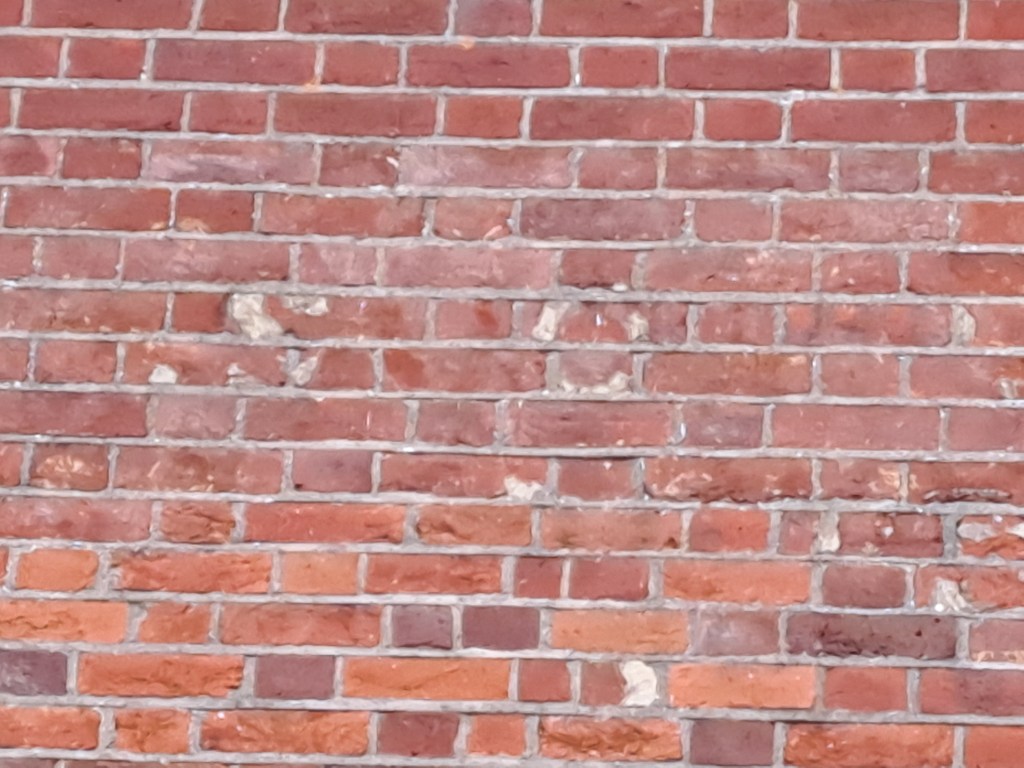
Some letters above the lintel:
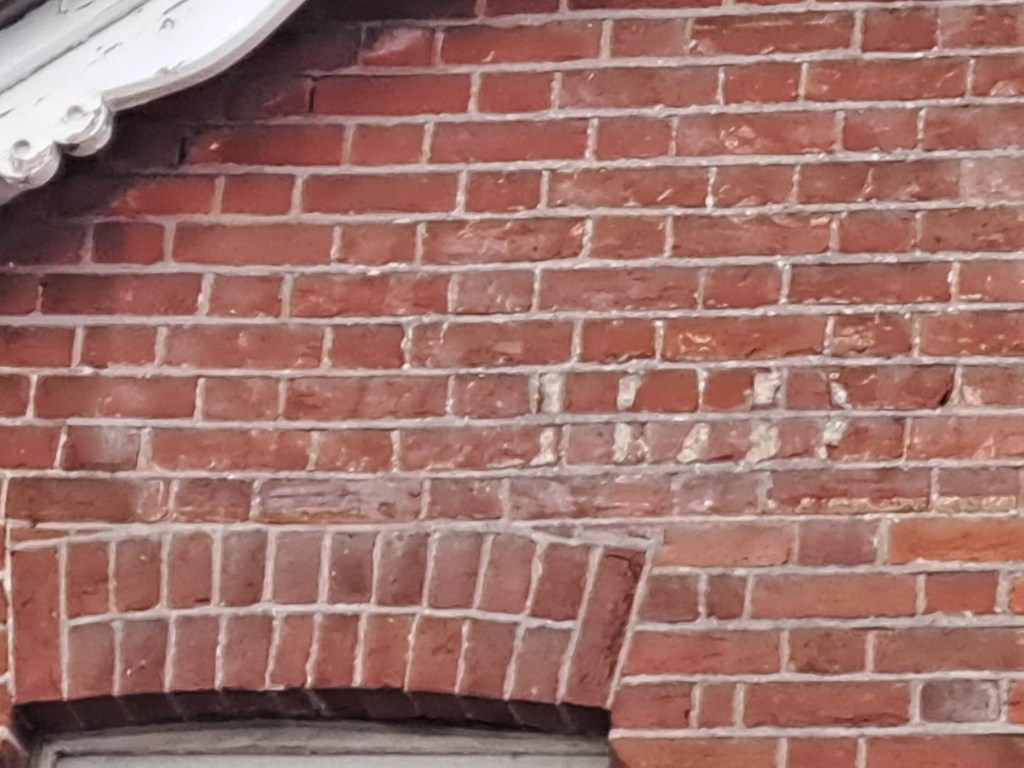
C T O R from the end of CONTRACTOR:

View of the side elevation, looking up the hill:
S O N is visible. Beneath that, the letters C T O R S, from the end of CONTRACTORS.

Zoomed in:

In 1898, the Kelly Directory lists Henry Scott, a builder, in Portland Street.
By the 1911 Kelly Directory, Henry Scott, builder, has a commercial address on Mount Pleasant Road (no number given). Henry’s private address is 4 Medina Avenue, a short walk away.
Moving to the 1927 Kelly Directory, the commercial address is still Mount Pleasant Road. It is now a family business: the listing is Scott & Son, builders.
The 1935 Kelly Directory gives two commercial addresses for Scott & Son, builders: 2 Medina Avenue and Mount Pleasant Road.
There are the same two addresses in the 1951 Kelly Directory. 2 Medina Avenue lists Henry F Scott. This time, a number for Mount Pleasant Road: number 9, as expected.
In the 1977 Kelly Directory, the residential street section has a Scott at 9a Mount Pleasant Road. There is no Scott & Son in the list of builders.
What more information can the genealogical databases tell us?
Henry Frederick Scott was born on 28 December 1876.
In the 1881 census, Henry is called Harry. He is 4 years old. The address is 105 Pyle Street, Newport. He lives with his parents, Harry (Henry) Scott (a Plasterer) and Mary Ann. Also in the household are his younger sister (Elsie), aunt (Emma Copper), a cousin and a lodger.
In the 1891 census, now aged 14, Henry is at 3 St John’s Road, Newport, with his aunt, Emma Cooper, and other relatives. He is at school.
In the 1901 census, Henry is at Dainhurst, 1 Shide Path, Newport with his parents Henry and Mary. Henry senior is a Builder. Henry junior is a Builder’s Assistant; he is 24 and single. Also present are two siblings, an aunt (Emma Cooper) and a cousin.
In the 1911 census, the spelling has changed to Danehurst, Medina Avenue. The household is down to three: Henry and his parents. Henry is now 34 and single, and still a Builder’s Assistant.
In the 1921 census, little has changed for Henry (aged 44) in his living arrangements. The spelling is back to Dainhurst, Medina Avenue. His occupation is now Builder. He still lives with his parents and is single.
In 1939, Henry F Scott is at 2 Medina Avenue, Newport. His parents have died. He lives with his younger brother Sydney and three other younger relatives. The male relatives are associated with the building trade.
Henry died on 10 January 1957, aged 80. He is buried in Carisbrooke Cemetery alongside his parents.
This Henry that I have traced through the records is the son in SCOTT & SON. He never married, for reasons we will never know. I plan to trace Henry senior through the records when I have time.
15
SELF PASTRYCOOK
The NOTED PIE SHOP
Location: 143 High Street, PO30 1TY
Currently occupied by Biscoes Solicitors.
A listed building. The Details section states that “the west gable end has a C19 painted shop sign.” The History section tells us that “an 1898 article in the Isle of Wight County Press and South of England Reporter states that 143 High Street was occupied by John Dawson Self, a restaurant-keeper and confectioner.”

My research shows that John Dawson Self was the occupier of 143 High Street in 1891, 1901 and 1911. His uncle, Thomas Self, occupied the property in 1871 and 1881. It could have been John Dawson or Thomas who commissioned the painted sign.
Why was this pie shop ‘noted’? Was it for the quality of the pies? Their affordability? The reliability of their supply? I can almost smell the pies as they finish cooking in the oven. Did John Dawson or Thomas make steak and kidney, my favourite? It’s possible. Wikipedia tells us that “according to the cookery writer Jane Grigson, the first published recipe for the combination of steak and kidney was in 1859 in Mrs Beeton’s Household Management.”
Take a closer look at the bricks. The top of the west gable end looks to be Flemish bond, but lower down it switches into a mix of styles. The front of the building is laid in header bond in purple-grey bricks, otherwise known as ‘lavenders’. Do visit the Isle of Wight Brickmaking History website to learn more about this local industry. There are some fascinating photos. My favourites are the barley sugar twist chimneys.
The Historic England listing above tells us the sign is nineteenth century. I wanted to see if I could place it in a narrower timeframe, and determine if Thomas Self or John Dawson Self was responsible for it, so I researched both men.
Thomas Self
Thomas Self was born on the Isle of Wight in 1816. He was baptised on 8 December 1816 at St Mary’s, Carisbrooke. Let’s follow him through the census.
1841. Aged 24.
Address: There is a Thomas Self, born in 1817, living in Crocker Street, Newport, and a different Thomas Self, born in 1816, living in Lugley Street, Newport. These two streets run parallel to each other, with a short distance between them. Did they know each other?
1851. Aged 34.
Address: Lower St James’s Street, Newport.
Occupation: Baker & grocer employing 1 man.
His birth place is Newport.
He lived with his wife Fanny (born in Arreton, Isle of Wight in 1819), daughter Fanny Saunders (born 1849), sister and female servant.
Marriage records show Thomas Self married Fanny Newbery in 1847 in Portsea Island, Hampshire. As they were both born on the Isle of Wight, I wonder why they crossed the Solent to marry?
1861. Aged 44.
Address: 150 High Street, Newport.
Occupation: Pastry cook employing 2 men, 1 boy. Thomas is developing his business gradually, adding a man and a boy since 1851.
His wife Fanny is present. Their daughter Fanny S is 12 and a scholar. Also living in the property are a female apprentice and a female servant.
1871. Aged 54.
Address: 143 High Street, Newport. The location of the wall ghost.
Occupation: Confectioner employing 3 men, 1 boy. Another man added to the payroll since 1861.
His wife Fanny and daughter Fanny S (now aged 22) are present, along with a niece, although none is given an occupation. A shop woman and two female servants make up the household.
1881. Aged 64.
Address: 143 High Street, Newport.
Occupation: Baker employing 3 men, 1 boy.
His wife Fanny is present. Their daughter Fanny Saunders has moved out. She married Benjamin Wallington Tilley in Camberwell, London in 1876. A female shop assistant and female servant also live in the property.
1891. Aged 74.
Address: Highfield, Castle Road, Newport.
Occupation: Retired baker & confectioner.
Thomas is a widower. Fanny died on 25 March 1888, aged 69. The Friends of Newport & Carisbrooke Cemeteries have a record of her burial.
Thomas is employing a live-in housekeeper.
Highfield is at 48 Castle Road.
Thomas Self died on 2 April 1899, aged 82. He shares a plinth with his wife Fanny.
A probate search for 1899 shows that Thomas divided his estate between his daughter Fanny Saunders Tilley and William Tucker Way Buckell, gentleman. The value was £6963 14s 5d. The Bank of England inflation calculator translates that into £745,000 in today’s money.
I stated above that Thomas Self was the uncle of John Dawson Self. Let’s see how.
Thomas Self was baptised on 8 December 1816 at St Mary’s, Carisbrooke. His older brother John was born on 18 September 1814, but not baptised until the same day as Thomas in 1816.
Their parents were John Self and Mary Saunders, who married on 13 December 1809 in Newport.
Thomas’ older brother John Self (the one born in 1814) married Elizabeth Esther Dawson on 18 June 1844 in Cowes, Isle of Wight. Elizabeth had been baptised on 22 February 1820 in Carisbrooke, Isle of Wight.
John Dawson Self
John Dawson Self was born on the Isle of Wight in 1852. We can follow him through each subsequent census:
1861. Aged 9.
Address: 42 High Street, Northwood. (There is no High Street in Northwood, so this must be Cowes).
Occupation: Scholar.
His birth place is Northwood, but that could also mean Cowes.
He lived with his father, John Self (a ‘Baker employing 1 boy’), his mother Elizabeth Self, his two older sisters, his younger brother, and a female servant.
1871. Aged 19.
Address: Sun Hill, Northwood. (Again, they mean Cowes).
Occupation: Baker. He is following the family trade.
His birth place is Cowes. He is still living with his parents, one of his older sisters and his younger brother. They no longer have a live-in servant.
1881. Aged 29.
Address as given in the census: 10 Buckingham Street, St Margaret and St John the Evangelist Westminster, St George Hanover Square, London & Middlesex. What a mouthful. St Margaret, St John and St George Hanover Square were civil parishes in either the City of Westminster or the Liberty of the City of Westminster.
Occupation: Cook. Did John Dawson move to London to further his career?
John Dawson is living with his wife Elizabeth (same age, 29, born in Berkshire) and their son, John Alfred Self. Looks like a family tradition of naming the first son John. Birth records show John Alfred was born in 1878 in St George Hanover Square. Marriage records show that John Dawson Self married Elizabeth Brooks in 1876 in Westminster.
1891. Aged 39.
Address: 143 High Street, Newport. The location of the wall ghost.
Occupation: Cook & confectioner.
John Dawson is living with his wife Elizabeth and son John Alfred, now 12, a scholar. There is also a daughter, Elizabeth F O, also a scholar, with a birth year of 1877, making her more than a year older than John Alfred. This begs the question of why she does not appear on the 1881 census. Birth records show that Elizabeth Florence Self was born in 1877 in St George Hanover Square. Another look at the 1881 census puts Elizabeth Florence back on the Isle of Wight. She is listed as the granddaughter of John Self, the head of the house. Also in the house are her grandmother, Elizabeth (too many Elizabeths: John Dawson Self’s mother was an Elizabeth, he married an Elizabeth and he named his daughter Elizabeth!), and her aunt and uncle (John Dawson’s siblings). They are living in Bath Road, Northwood (actually Cowes). I wonder why Elizabeth Florence was not living with her parents in London in 1881? By 1891, the family were reunited.
Back to 143 High Street, Newport. There are two other young women at the address, a servant and a shop assistant. Why did John Dawson move back to the Isle of Wight? His uncle, Thomas Self, had a daughter but no sons. Did Thomas, thinking about retiring, reach out to John Dawson and offer him the chance to keep the family business going? Or did John Dawson seek out the opportunity himself? Did he think it would be beneficial for career or family reasons, or a combination of both, to move back to Newport?
A little more information about John Dawson’s wife, Elizabeth. Her birth place is Woolhampton, Berkshire.
1901. Aged 49.
Address: 142 Shop, 143 High Street, Newport. House numbers on this street are consecutive, not odd/even, so 142 was next door to 143. They seem to be occupying two properties.
Occupation: Confectioner.
John Dawson is living with his wife Elizabeth. His children John Alfred (aged 22) and Elizabeth Florence Olive (aged 23) are also present. This is a family business: John Alfred is a Confectioner’s assistant, and Elizabeth Florence Olive is a Shop assistant. No occupation is given for their mother, Elizabeth. Like she didn’t have one!! Perhaps the men worked in the kitchen, and the women were front of house? There is also a servant in the household.
An oddity: wife/mother Elizabeth has a birth place of Wolverhampton, Staffordshire. The 1891 census gives it as Woolhampton, Berkshire. Mmm …. Wolverhampton, Woolhampton. The 1881 census above told us she was born in Berkshire. I’m going with Woolhampton.
As the head of the household, John Dawson Self would have completed the census schedule that the census enumerator had left, entering the place of birth for everyone living there. The enumerator would have returned to collect the schedule and copied all the details into an enumeration book. Is this where the mistake crept in? Surely John Dawson knew where his wife was born and entered it correctly in the schedule. John Dawson’s handwriting might have been poor, or the enumerator might have been tired or distracted. You can see how it happened.
(Brief aside: the 1898 Kelly Directory of the Isle of Wight lists John Dawson as a beer retailer as well as a confectioner).
1911. Aged 59.
Address: 143 High Street, Newport.
Occupation: Baker and confectioner.
John Dawson and his wife Elizabeth are still living together, and the business is still going. Their son John Alfred is living with them. His age is given as 31, although it was likely to be 32. John Alfred has the same occupation as his father, Baker and confectioner. Elizabeth Florence Olive has moved on: she married Frank Shutler in 1907 in Newport. There is no live-in servant.
1921. Aged 69.
Address: Lukely Lodge, Humall, Newport.
Occupation: Confectioner Retired.
John Dawson has taken a probably well-earnt retirement and moved house, but stayed in Newport. He is living with Elizabeth and John Alfred. Elizabeth finally has an occupation – Home Duties – which of course she was doing for decades. John Alfred has left the family business of baking, and is now a clerk to a coal merchant called F Shutler. Remember who Elizabeth Florence Olive married?
John Dawson and his wife and son lived at Lukely Lodge. Humall struck me immediately as an error. I guessed at The Mall, the part of Carisbrooke Road with the raised, wide pavements on both sides. I was correct. The address is 94 Carisbrooke Road, Newport, PO30 1DB.


Lukely Lodge is a substantial, 5 bedroom detached house. Due to the wonders of online house-selling, you can see photos of the inside if you desire. I’ll leave you to find the website. If you told John Dawson Self that it would sell for £590,000 in 2021, would he have comprehended how inflation changes the value of money over time?
(I’m researching when Lukely Lodge was built. It existed in 1904, as these entries from Kelly’s 1904 Isle of Wight Directory show. Scroll down to The Mall. The Reverend George Avery was the occupant).
I researched John Dawson Self’s daughter, Elizabeth. She married Frank Shutler in 1907 in Newport. The 1911 and 1921 censuses put them at the same address: 123 Lower St James’s Street, Newport. (Confusingly, the surname in 1911 is transcribed as Shuker). They had three children. Ronald F D Shutler was born in 1908 and died in 1936. Olive Betty Shutler was born in 1916 and died in 2007. Julian Neil Shutler was born in 1918 and died in 2019. That’s right: one of John Dawson Self’s grandchildren was alive until five years ago.
John Dawson Self died on 27 March 1923, at the age of 71.
Elizabeth Shutler died on 13 January 1924 at the age of 47, less than one year after her father. Here is her grave inscription. Her husband Frank Shutler died on 15 December 1943, aged 60.
Elizabeth Self died on 24 July 1943, at the age of 92. The inquest into her death concluded that she died from natural causes i.e. chronic myocarditis and arteriosclerosis accelerated by a fracture of the right tibia and fibula sustained in accidentally falling at Vectis Nursing Home, Ryde. (Source: Coroner’s Expense Report via the IOWFHS website).
Elizabeth Self and John Dawson Self are buried together at Carisbrooke (Mount Joy) Cemetery. The Friends of Newport & Carisbrooke Cemeteries have transcribed the inscription on their grave.
John Alfred Self continued living at Lukely Lodge until his death on 25 March 1965, at the age of 86. His grave inscription has also been transcribed.
John Dawson Self died a wealthy man. A probate search for 1923 shows that he left his estate to his son, John Alfred Self. The value was £13,970 19s 5d. In today’s money, that’s £703,000. His widow Elizabeth left her estate to John Alfred Self in 1943. The value was £9421. Today, that would be £357,000.
We’ve learnt that John Dawson Self ran a successful business for decades, he lived in a desirable property, he had the means to enjoy a comfortable retirement, and he left a substantial estate to his son. Might we be a little envious of his status? When we learn more about his death, our feelings might change.
The Friends of Newport & Carisbrooke Cemeteries have transcribed articles from the Isle of Wight County Press relating to the deaths of notable people. Here is the report of John Dawson Self’s death. It isn’t easy reading.
My heart goes out to John Alfred Self. His father has committed suicide while being of unsound mind. His mother is in a mental hospital. His sister, Elizabeth Shutler, is unable to attend the funeral on account of ill health. John Alfred isn’t married, so has no wife to share the burden with. The Coroner described the circumstances as exceptionally sad. John Dawson Self’s comfortable position in life offered him no respite from the pain of depression.
To return to the question of the age of this wall ghost … Thomas Self could have commissioned it in the period before the 1871 census and after the 1881 census when he occupied 143 High Street. Alternatively, John Dawson Self and his family are there on the 1891, 1901 and 1911 censuses. They moved from London to the Isle of Wight between 1881 and 1891. I imagine John Dawson wanted to make a success of his new business, given the effort involved in relocating his family from London. Remember the wording on the sign – The NOTED PIE SHOP. Perhaps Thomas’ shop had developed a good reputation, which John Dawson wanted to build on by commissioning the sign.
We know that on the 1921 census, John Dawson Self and his family had moved to Lukely Lodge. What became of the pie shop at 143 High Street? The 1921 census tells us that two different families were occupying the property. William G Critchell, a Carpenter and Joiner, aged 33, lived there with his wife Lillian S, aged 28, and their newborn baby Peter L. The other family were Edward T Sibbick, aged 39, a Motor Driver for a haulage contractor, his wife Ethel M, aged 29, and their son, 1 year old Donald T. So nothing to do with baking, confectionery or brewing. The inhabitants of Newport had to shop elsewhere if they wanted a pie.
The sign on their former shop would have been visible to Thomas, John Dawson, Elizabeth and John Alfred as they continued their lives in Newport until they died. What did they feel as they walked past it? Did they remember their customers? Perhaps they had some amusing anecdotes to tell. What would they have thought if they knew that people still look at the sign in 2024, and wonder what those pies tasted like?
16 and 17
SHEPARD BROS
Locations: 1 Little London and 3 Little London, PO30 5BS
1 Little London:
Most photos taken from the corner of the Little London car park.
You would be forgiven for thinking this is just a blank wall. It isn’t. Don’t take my word for it, go and take a look yourself before it fades away completely. You might get a few strange looks, but it’s worth it.
Image taken 3 May 2024:

Image taken 17 September 2019:

This one was seriously hard work. I made a breakthrough thanks to my daughter, who told me to use Google Street View because you can ‘go back in time’.
The image below was taken in July 2009. Zoom in and you can read SHEPARD BROS, level with the guttering. Note that the ‘S’ at the end of BROS is smaller and placed higher up. Above this ‘S’ are the letters ‘LTD’.
There are more letters lower down. Right of street lamp. Capital ‘R’, a gap, ‘M’, probably followed by ‘O’ and ‘V’:

Right of street lamp. Second row. ‘H’? ‘O’? ‘U’?
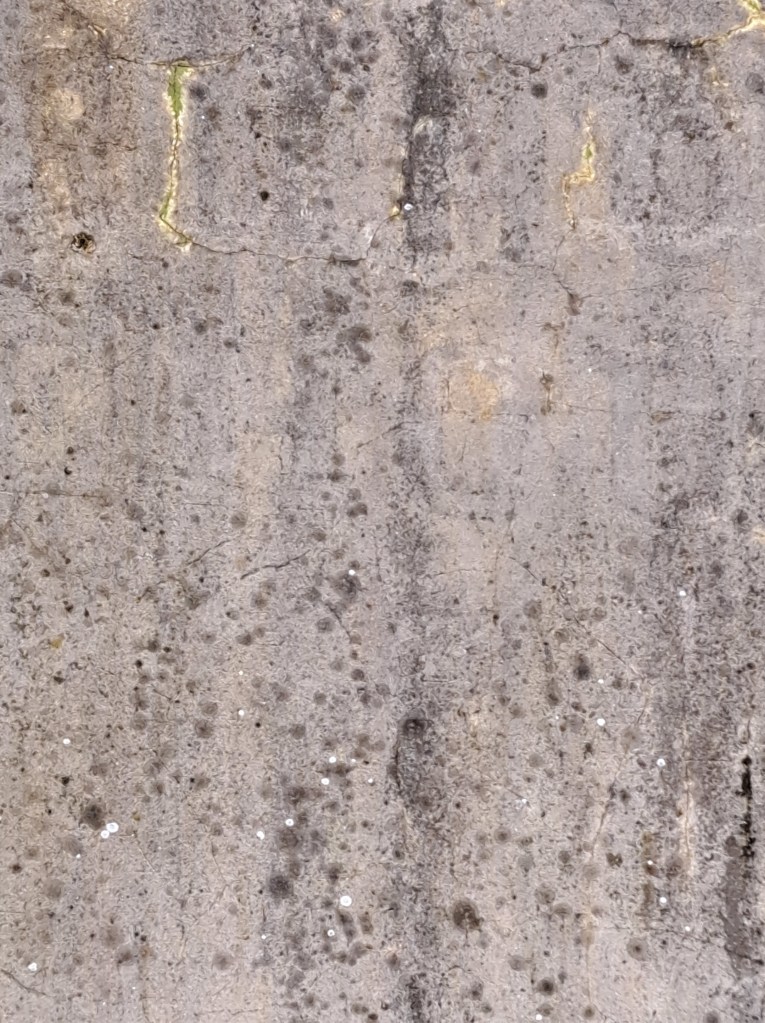
Right of street lamp. A closer look at the possible ‘O’ and ‘U’:

Left of street lamp. Capital ‘T’ in italics. The easiest letter to read on this wall ghost.
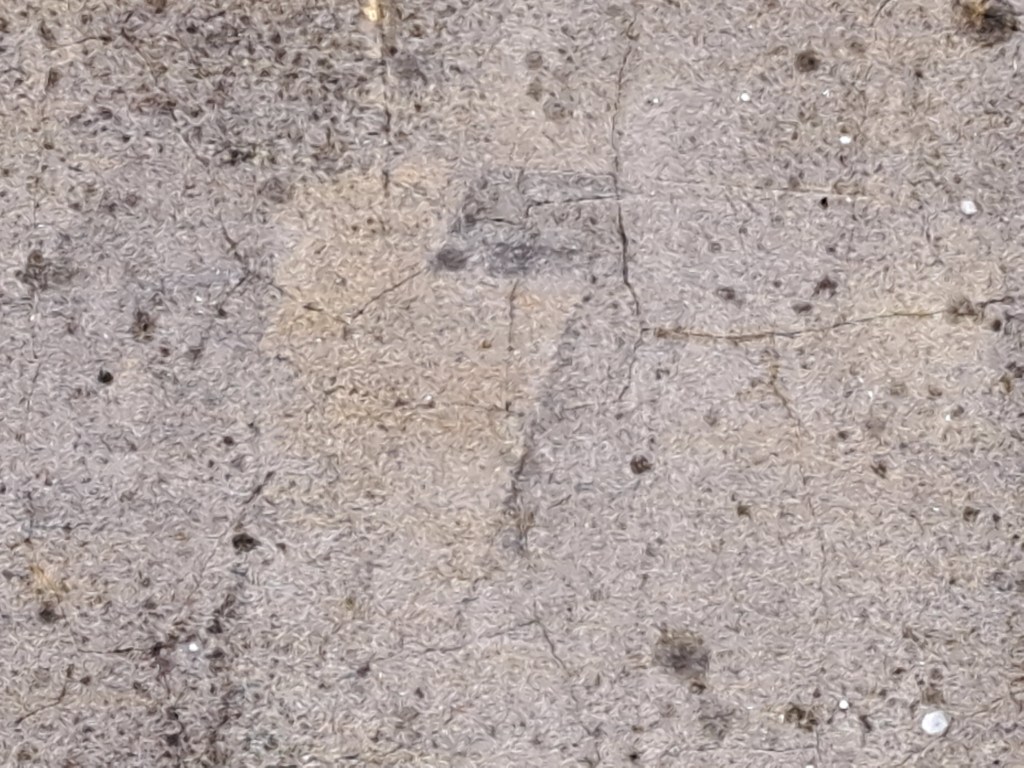
Left of street lamp. Some more ghostly letters.
The postcard below is reproduced on page 14 of ‘A History of Newport Quay and the River Medina’ by Bill Shepard and Brian Greening (2008). This book can be borrowed from the Isle of Wight Library Service. The book tells us the image is from around 1900.
This is clearly a different building, but it’s only just around the corner at 19 Sea Street. The warehouses on the right which were not demolished now form the Quay Arts Centre.
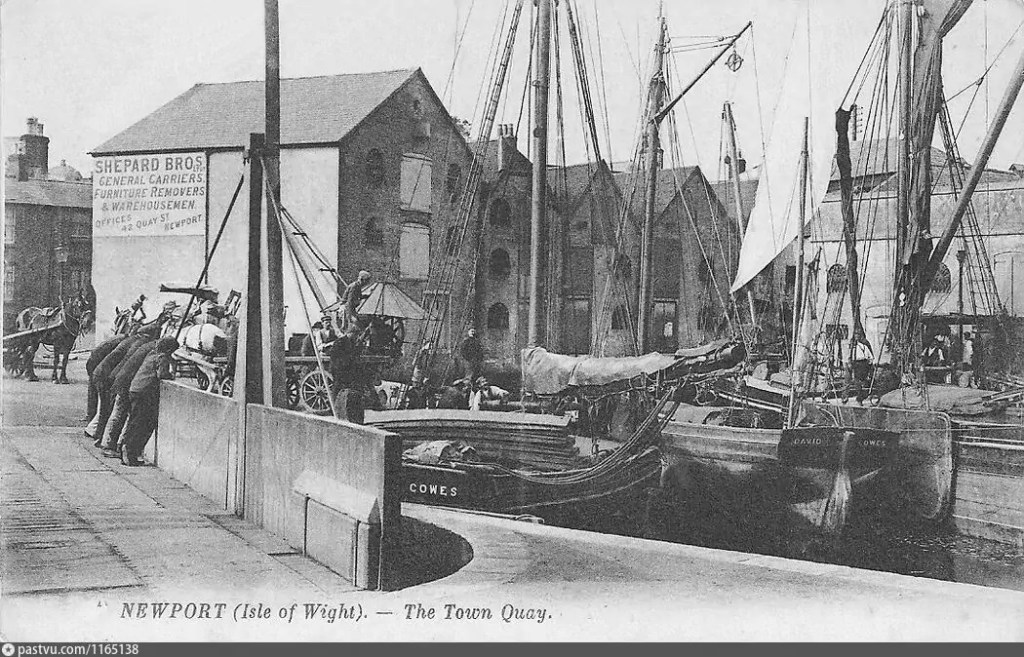
The sign says:
SHEPARD BROS LTD
GENERAL CARRIERS
FURNITURE REMOVERS
& WAREHOUSEMEN
OFFICES 42 QUAY ST NEWPORT
I consulted as many books as I could find with old photos of Newport. I had a moment of joy when I turned to page 85 of ‘Every Picture Tells A Story’ by Bill Shepard and Brian Greening (2005).

There is the wall ghost, before it faded!
The sign says:
HOUSEHOLD REMOVALS
EST. 1860[?]
SHEPARD BROS LTD
FURNITURE & [?] REMOVED
[A line both obscured by junk and very faded]
[Pile of junk] FREE
QUAY ST [running down on the right]
The book tells us that this is W. Hurst’s old yard in Sea Street. Today we know this shop as selling a wide range of goods for the home. They started out as ironmongers in the nineteenth century. The yard was the site of their foundry. Scrap metal was stored there before being melted down.
The ‘R-MOV’ I identified above must be from REMOVED.
The ‘HOU’ is from the very faded line below REMOVED. The sign on 19 Sea Street had the word WAREHOUSEMEN. It could be this, or WAREHOUSING.
The visible ‘T’ comes before FREE.
Did the two signs exist at the same time?
Below is 19 Sea Street, as it is now. Six windows have been added to one wall, plus two windows in the attic.

Back to 1 Little London. On the bottom left of the wall is a ghost of a ghost. What did this notice say?

3 Little London.
On 20 July 2024 my friend Jo Cooke alerted me to a photo of a faded wall ghost in the book ‘Out of Time, Volume 2’, which contains many old photos of Newport. Page 113 has a photo of the side of 3 Little London, taken on the day of the devastating fire at Mew Langton Brewery in 1979. This sign would have been visible to anyone travelling on the train into and out of Newport. I could only pick out a few letters, P A T.

On 26 July 2024 I took Ashley Webb and Lucy Bradley from the Newport and Carisbrooke Heritage Society on a walk around Newport, pointing out quirky plaques and signs. We included 3 Little London on our itinerary. Ashley beat his way past some overhanging branches and we were able to read –
SHEPARD BROS
FURNITURE REMOVED
PACKED & WAREHOUSED
It seems to be a replica of the sign on 1 Little London.
I struggled to take any good photos, given the shadows cast by the shrubs and trees and the uneven ground we were standing on.
Top row: F U R N
Bottom row: A C K E
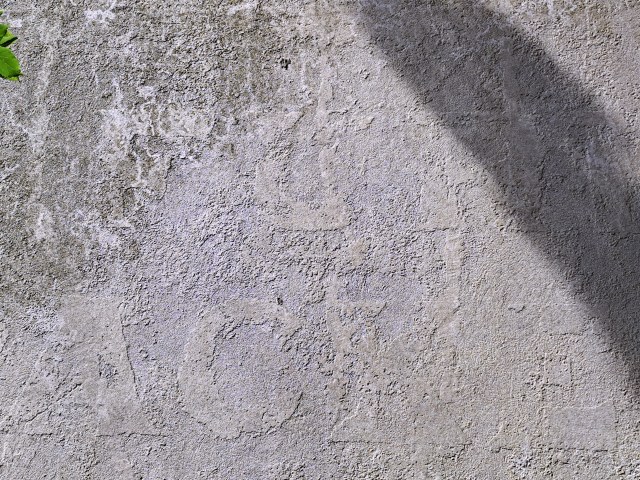
P A C K

A C K E
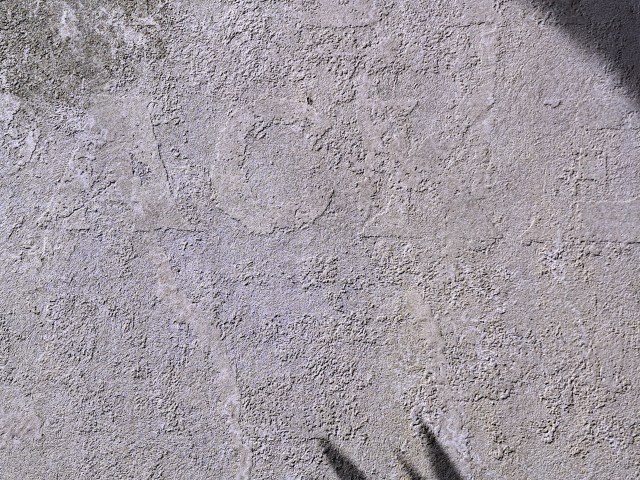
Returning to my speculation above on 1 Little London that the ‘HOU’ is from inside the word WAREHOUSE, I now believe that line on 1 Little London (obscured by junk and very faded) says PACKED & WAREHOUSED to match 3 Little London.
Did Shepard Bros own both 1 and 3 Little London, and rent out living accommodation to their staff? The 1921 Census tells us that 1 Little London was occupied by E H Knight, his wife and five children. E H Knight was 44, his occupation was Mariner, and his employer was …. Shepard Bro Ltd General Carriers!! For some reason, there is no entry for 3 Little London.
Looking again at the photo on page 113, the SHEPARD BROS letters we could read are on the lower half of the wall, whereas the letters I can make out in the photo – P A T – are on the upper half of the wall. Is it possible there were two different signs on this wall, at different points in time?
18
WADHAM
Location: opposite Ladbrokes, 38 Pyle Street, PO30 1XB. Between Toto and God’s Providence House.
The W A D H A are visible. Most of the M has faded away. Looks like white paint, directly onto the wall.


I discovered this wall ghost on 22 May 2024. I was walking up Pyle Street, on the other side of the road, actively looking for letters on walls. I doubt I would have seen it had I been walking down the road, as the angle would have been wrong. As with Howard Causton above, I must have walked past here hundreds of times and not seen it before.
God’s Providence House to the right.

The Wadham in question was Stanley Wadham, auctioneer and estate agent. He was the youngest son of Charles Wadham, who started the well-known Wadham furniture store in 1860. It occupied 20 St James’ Square for many years, the building which then became Topshop/Topman.
Stanley rented 14 St Thomas’ Square, the Charter House. When viewed from St Thomas’ Square, the Charter House is a deep red brick building. It may surprise you to learn that, adjoining it to the east and part of the same premises, is a house which is contemporary with God’s Providence House (number 12) and numbers 13 and 13A, and continues their old tiled roof. The map on the Historic England entry (look for the blue triangle) shows how this building extends back to Pyle Street. Stanley made use of that wall on Pyle Street to advertise his business. Perhaps there was also some text to direct people to enter the building around the corner in St Thomas’ Square.
Stanley Wadham died in 1960. The Friends of Newport and Carisbrooke Cemeteries have transcribed the Isle of Wight County Press report.
Under the first A in WADHAM there is a gap, then a D to right of the grey vent. There might be a R after the D, but it is very faded.

19
WRAY & SONS LTD
Location: 6-8 Carisbrooke Road, PO30 1BL
The ground floor is currently occupied by a RSPCA charity shop.


This sign is on smooth blocks, not bricks. It’s hard to say whether it uses paint or another medium. I’ve included it to avoid people contacting me accusing me of not knowing Newport properly. It certainly has that faded quality that the best wall ghosts display.
Wray and Sons were grocers, with a reputation for high quality and a loyal clientele. Here are some old photos, in colour. Were your eyes drawn first to those cakes and buns? Mine were.
In the ‘olden days’, if you wanted a loaf of bread, a piece of fish, some cod liver oil and some apples, you had to go to four different shops. Give me a supermarket any day.
Wray and Sons were also one of the largest bakers on the Isle of Wight. A bakery at the rear of the property supplied other branches of Wray and Sons.
The Friends of Newport and Carisbrooke Cemeteries have transcribed the Isle of Wight County Press reports of the deaths of men connected with Wray and Sons:
Edward James Wray, 1918, (transcribed by Kate MacDonell).
Frederick James Wray, 1950, (transcribed by Rosemary Stewart).
Bertie Howard Wray, the son of Edward James Wray, was killed at Gallipoli in 1915.
The Future?
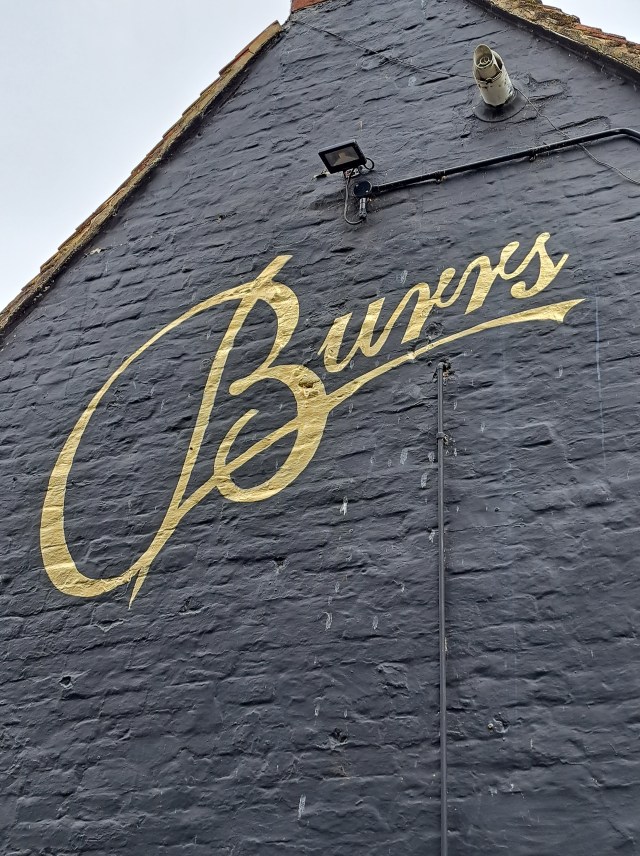
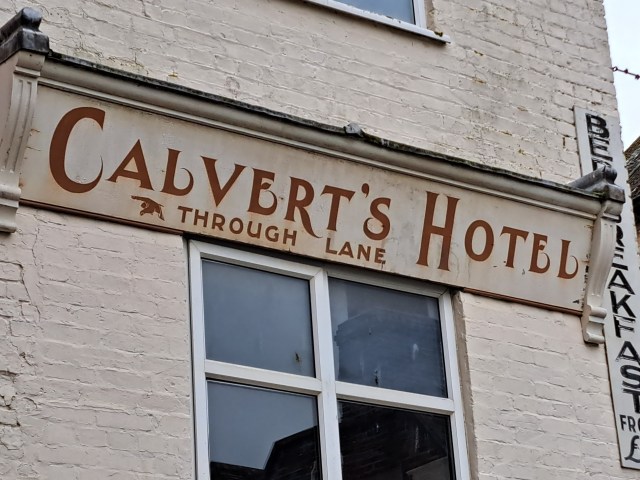
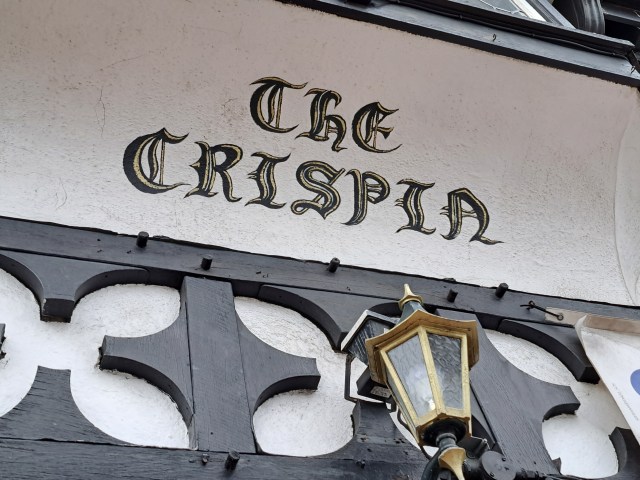
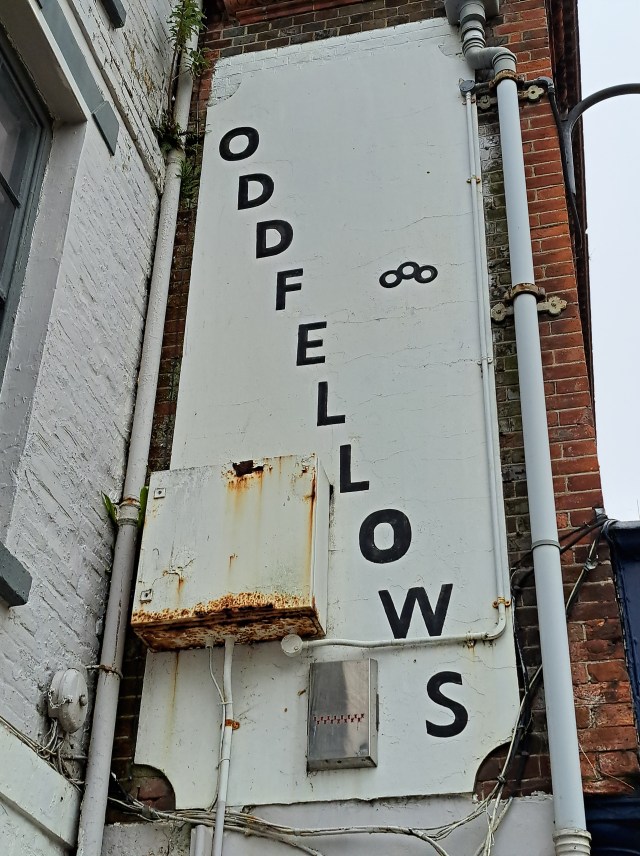
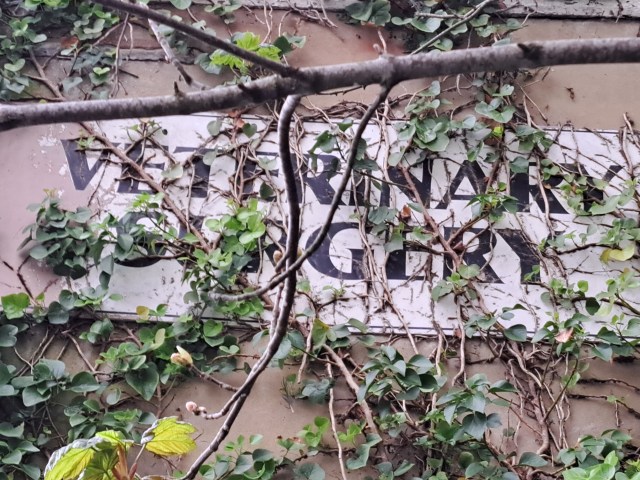
Let’s hope the businesses below continue for many years to come. If their fate is to become wall ghosts, here are some images while the painted signs are easy to read (except the last one).
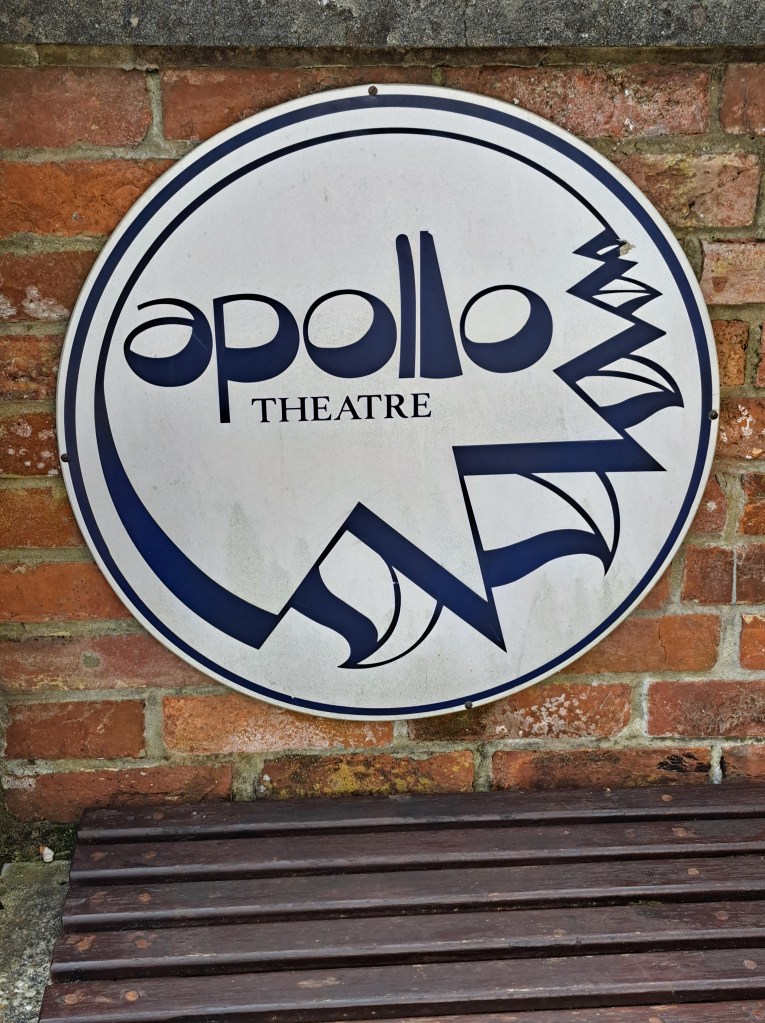


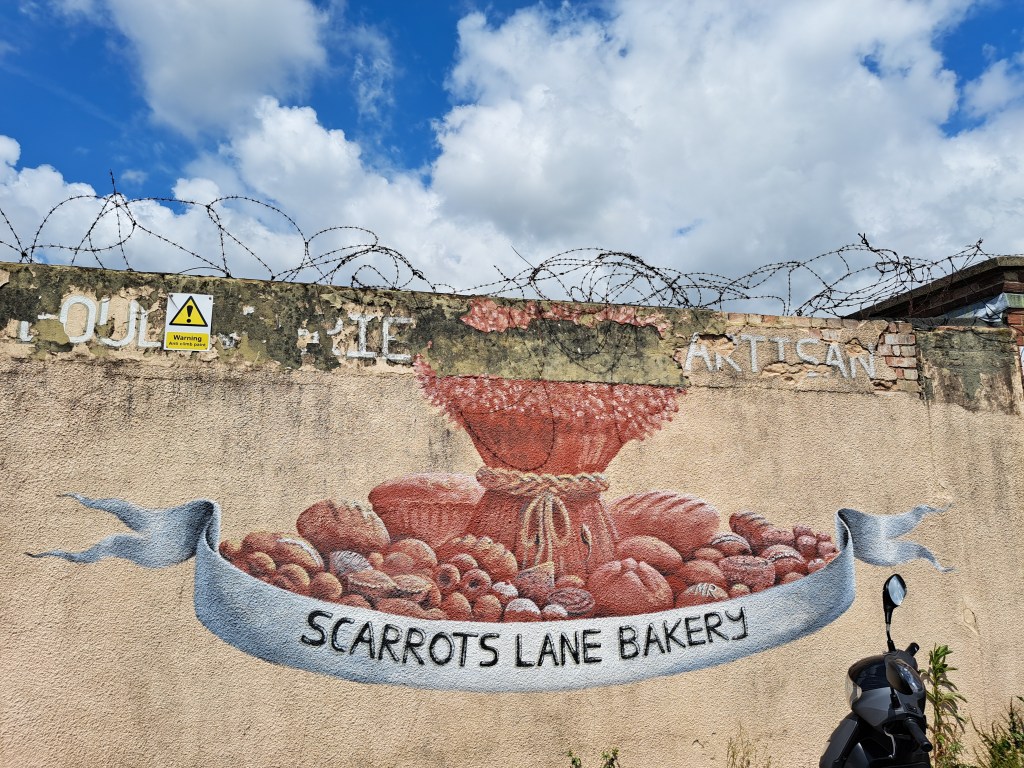
Boulangerie Artisan

Page published 29 April 2024. Text updated May-October 2024.
Thanks to: Anna Kavanagh for proofreading.
Thanks to: Jo Cooke (Library Supervisor, Isle of Wight Library Service) for sharing ideas and additional research, for spotting the Board Schools wall ghost when we walked around Newport together, and for telling me about the Scarrots Lane Bakery sign in the car park.
 Debbie Pledge